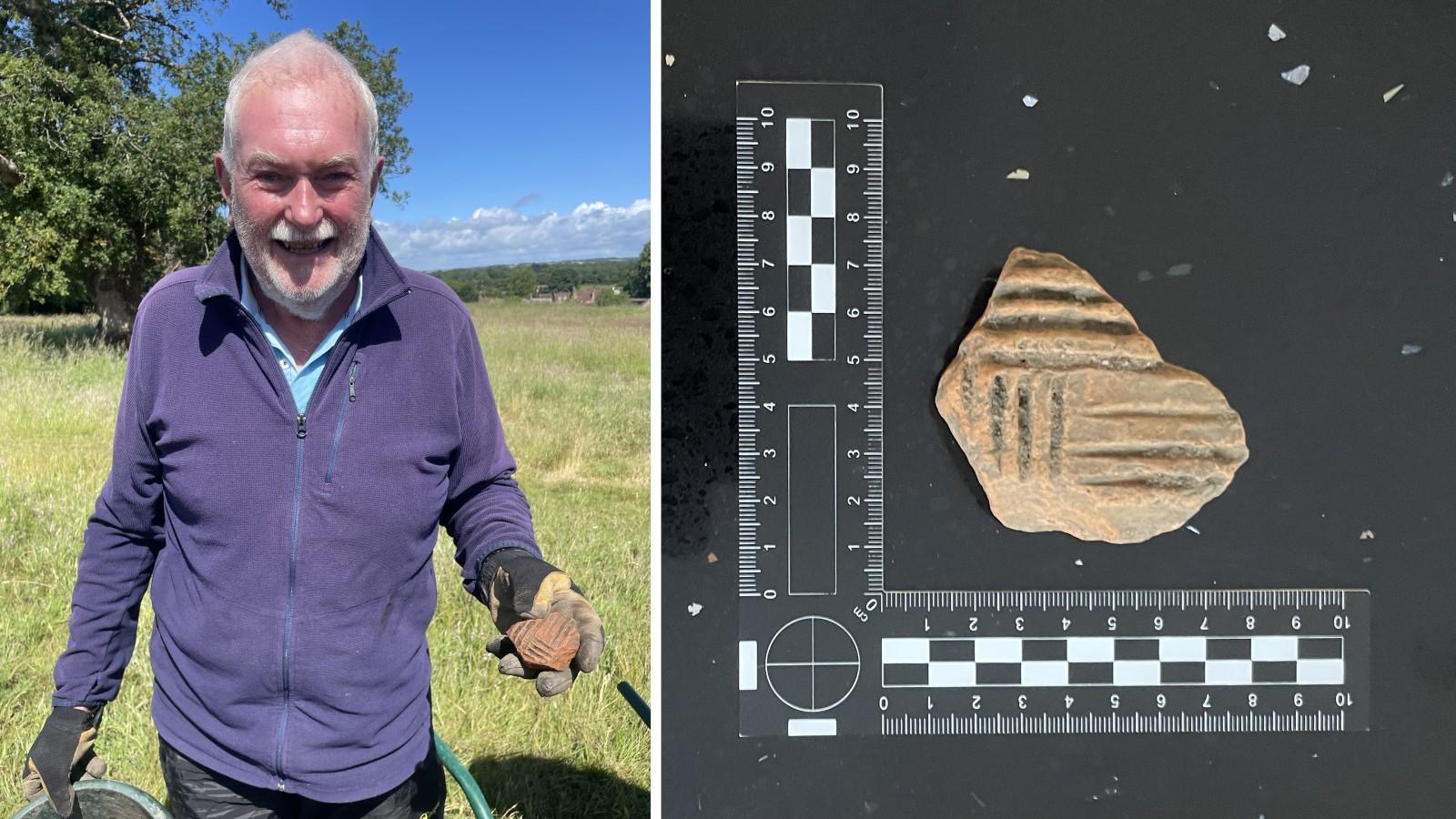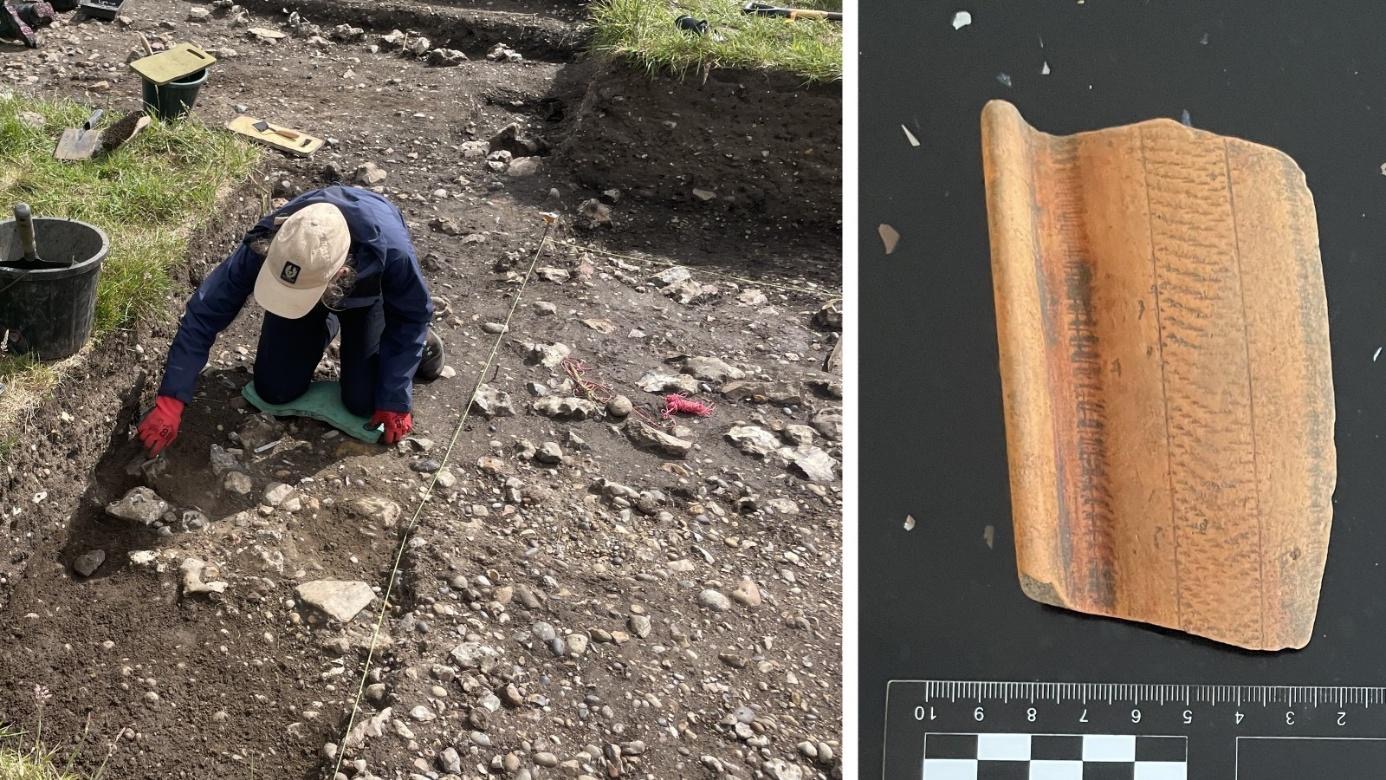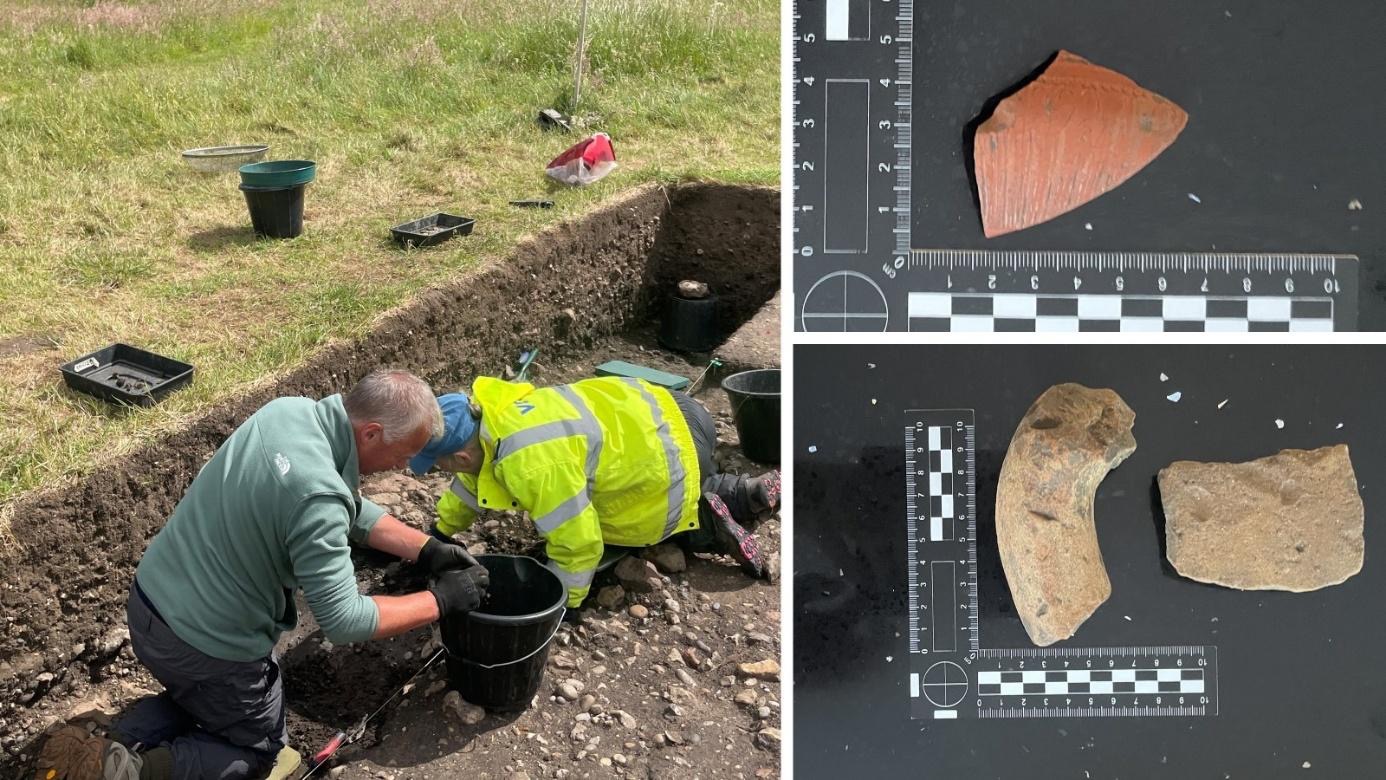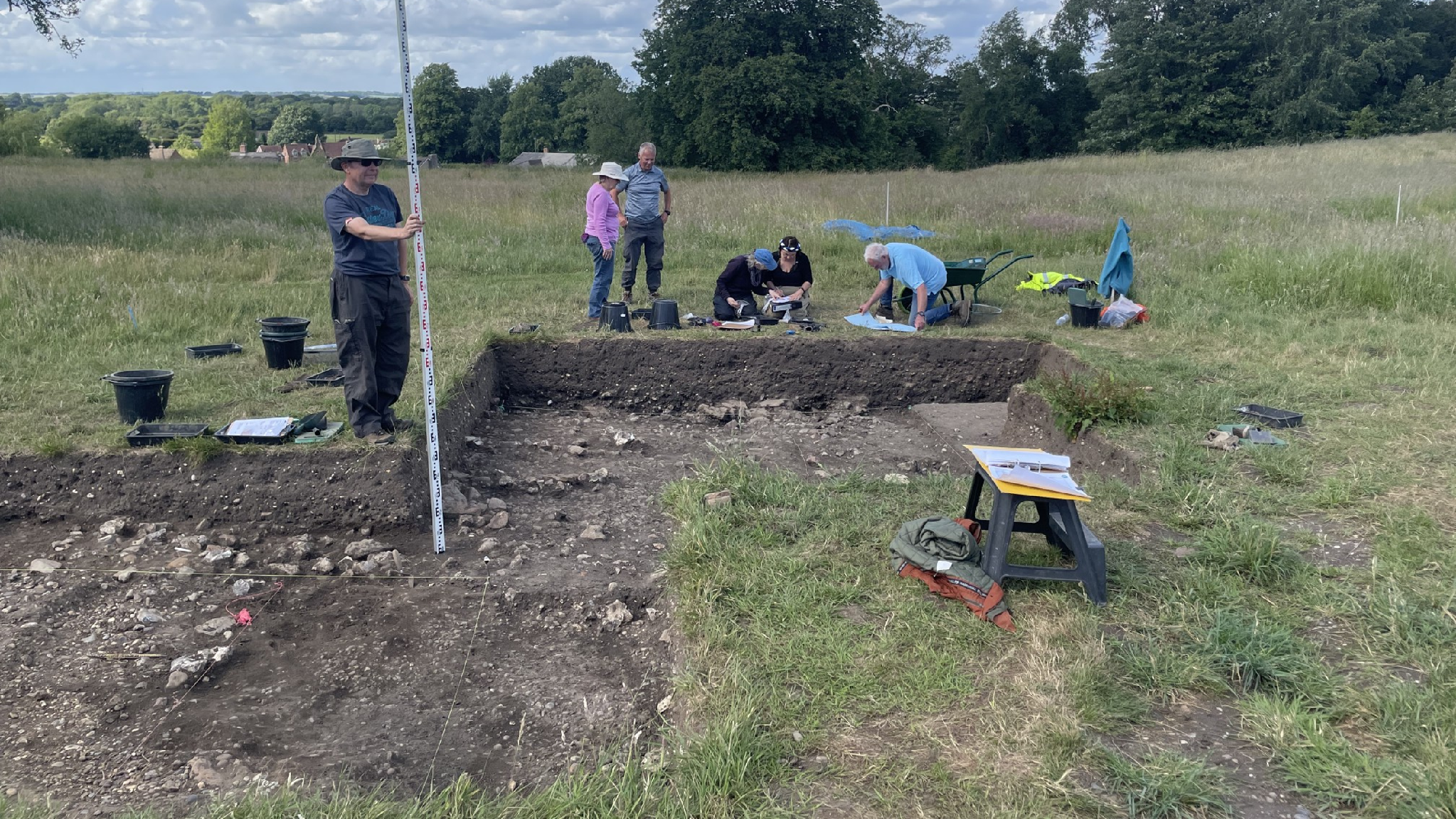
Wickham House 2026 – Day #21 Blog (14th May)

Part of a series of bulletins from the BAS excavations at Wickham House

Follow the project on our YouTube channel

Attendees: Julian, Geoff, Merrill, Gordon, Gill, Jill, Margaret, Debbie C, Peter Ca, Peter Cl, Fiona, Chloe, Doug, Ben C, Matthew, Phyllida, Lindsey and Keith 

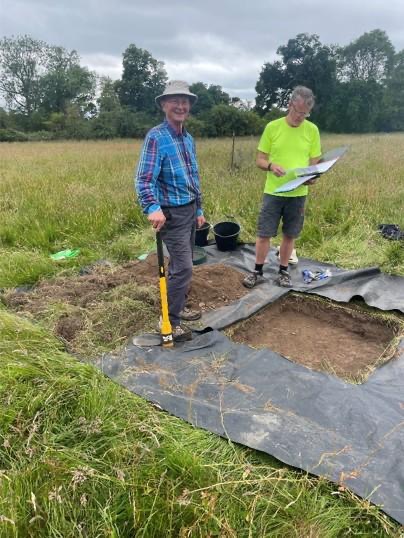
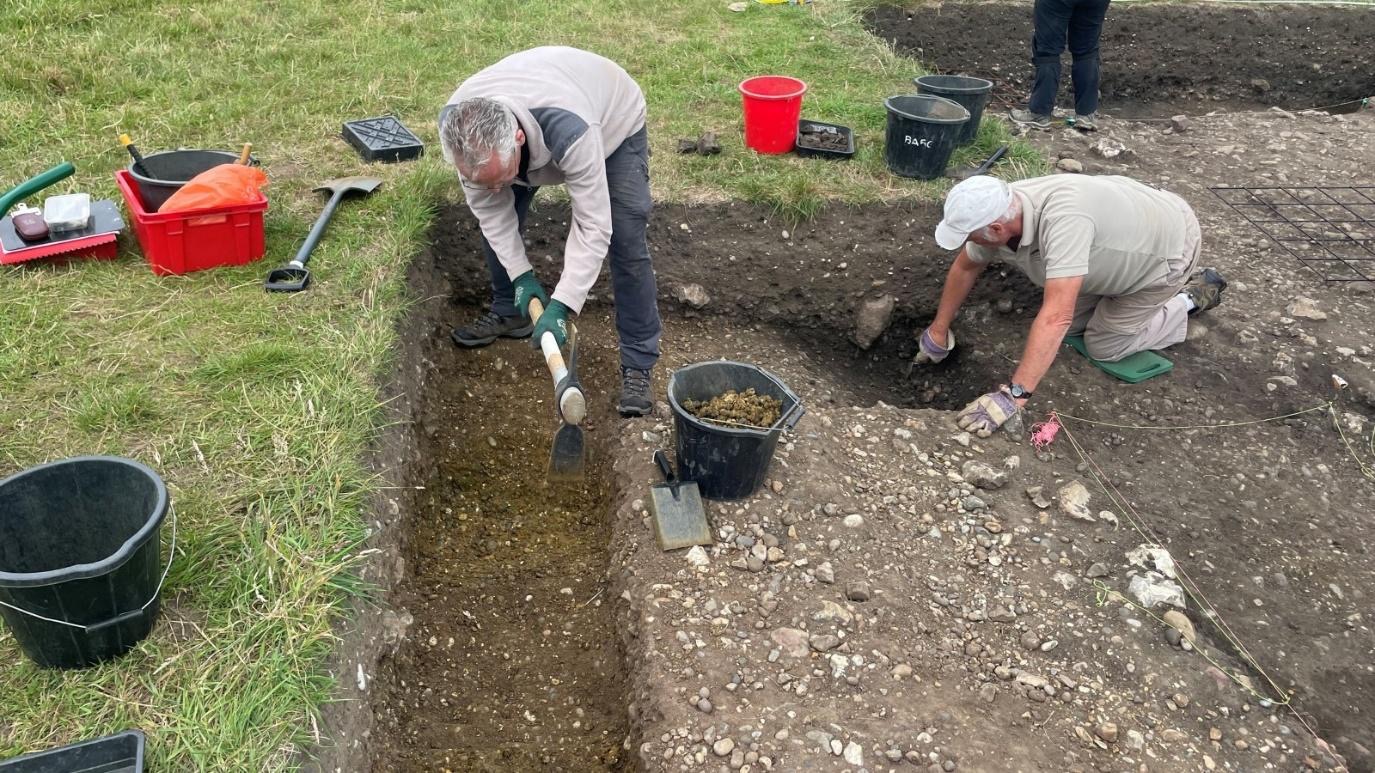
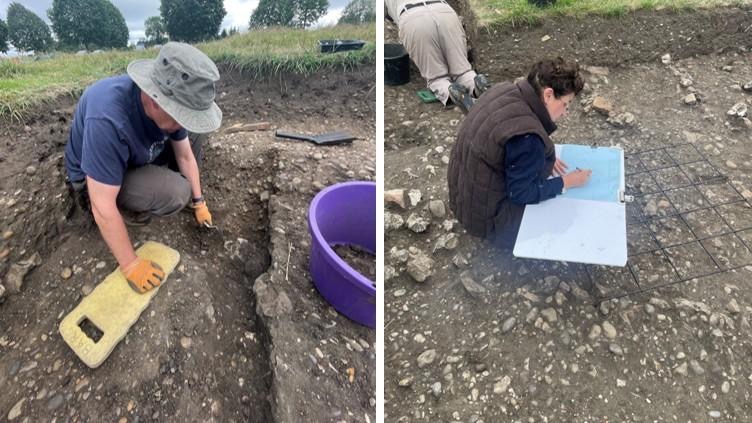
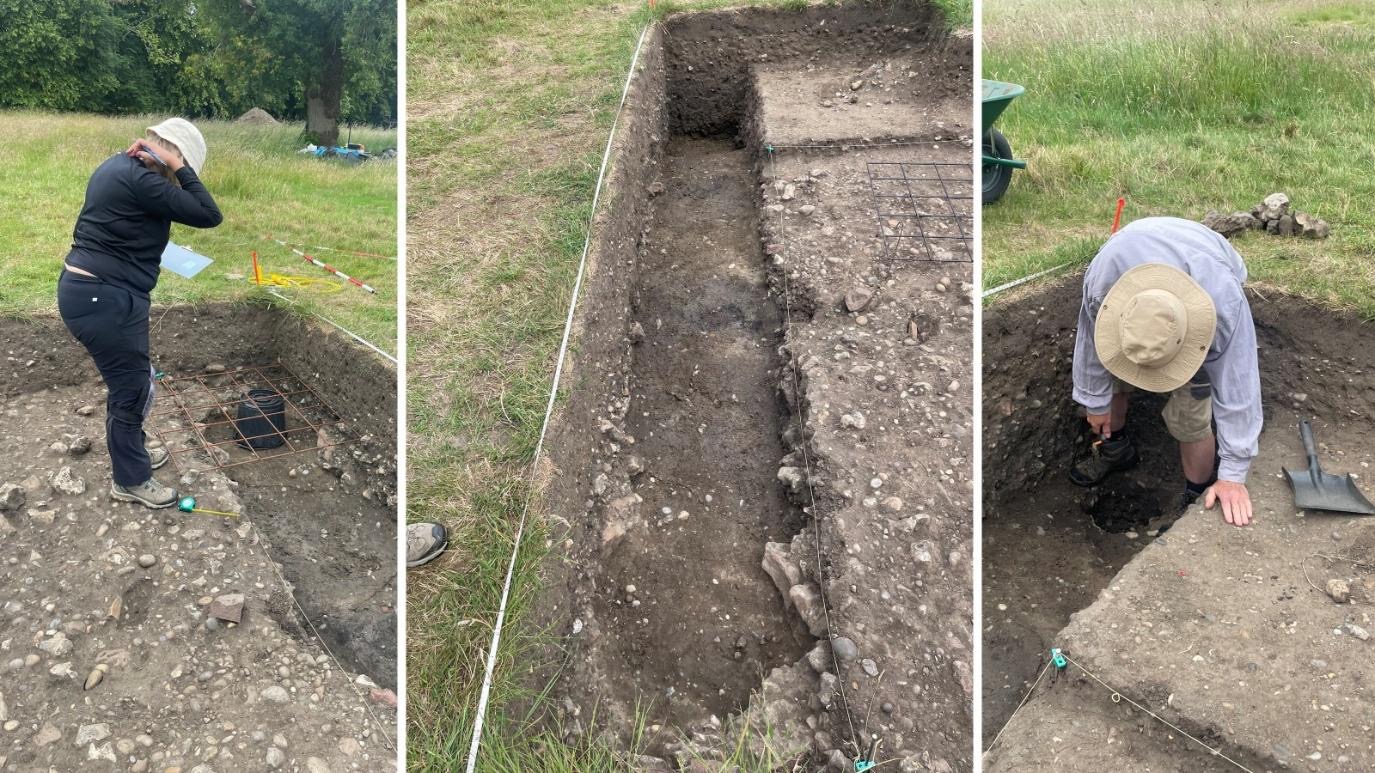
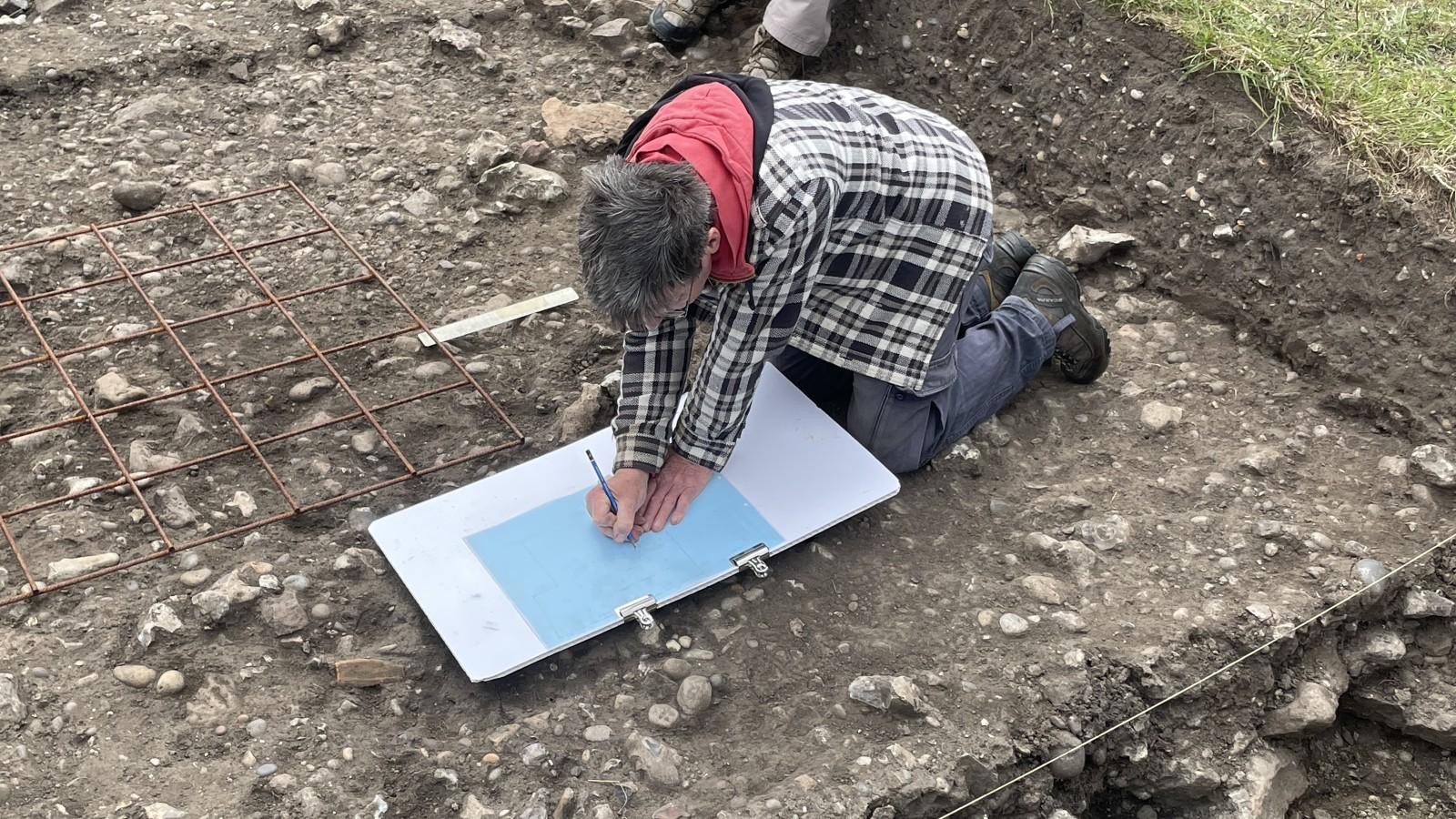
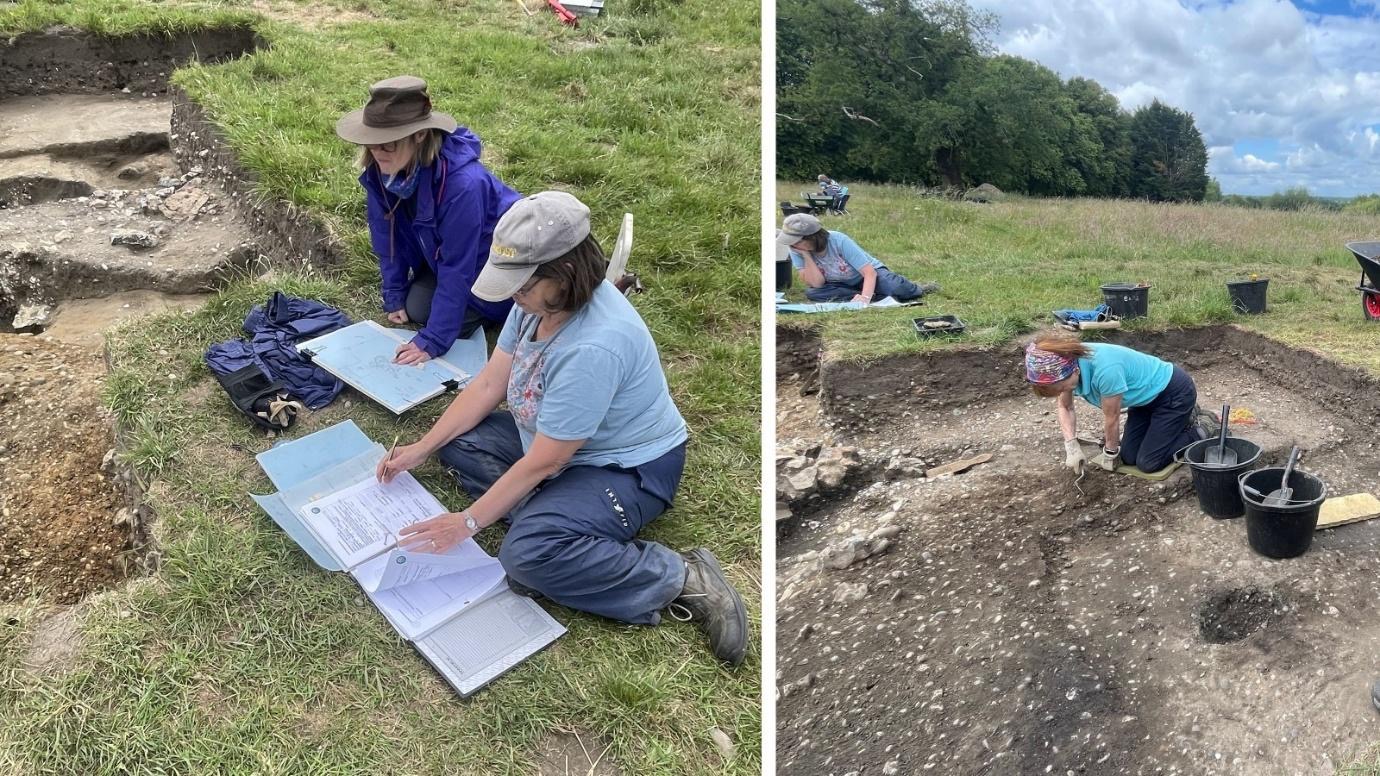
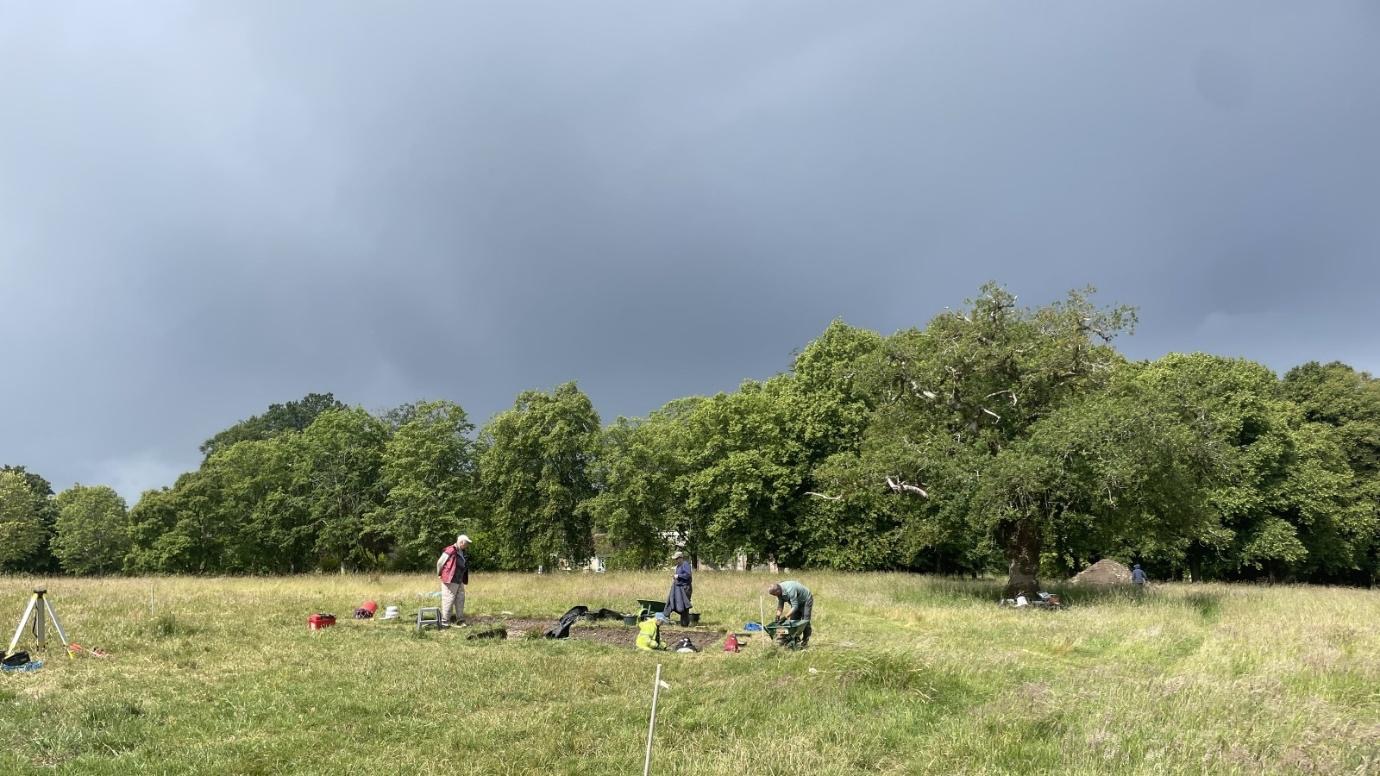
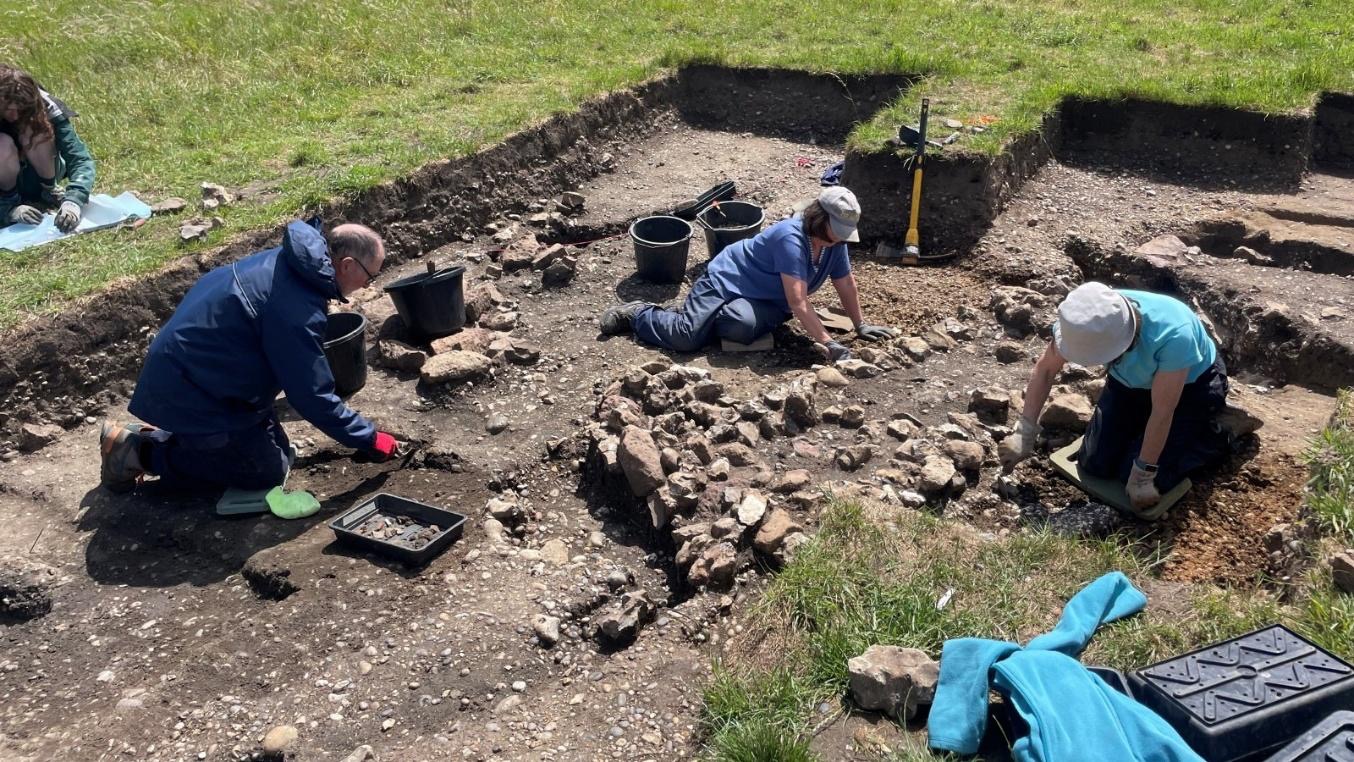
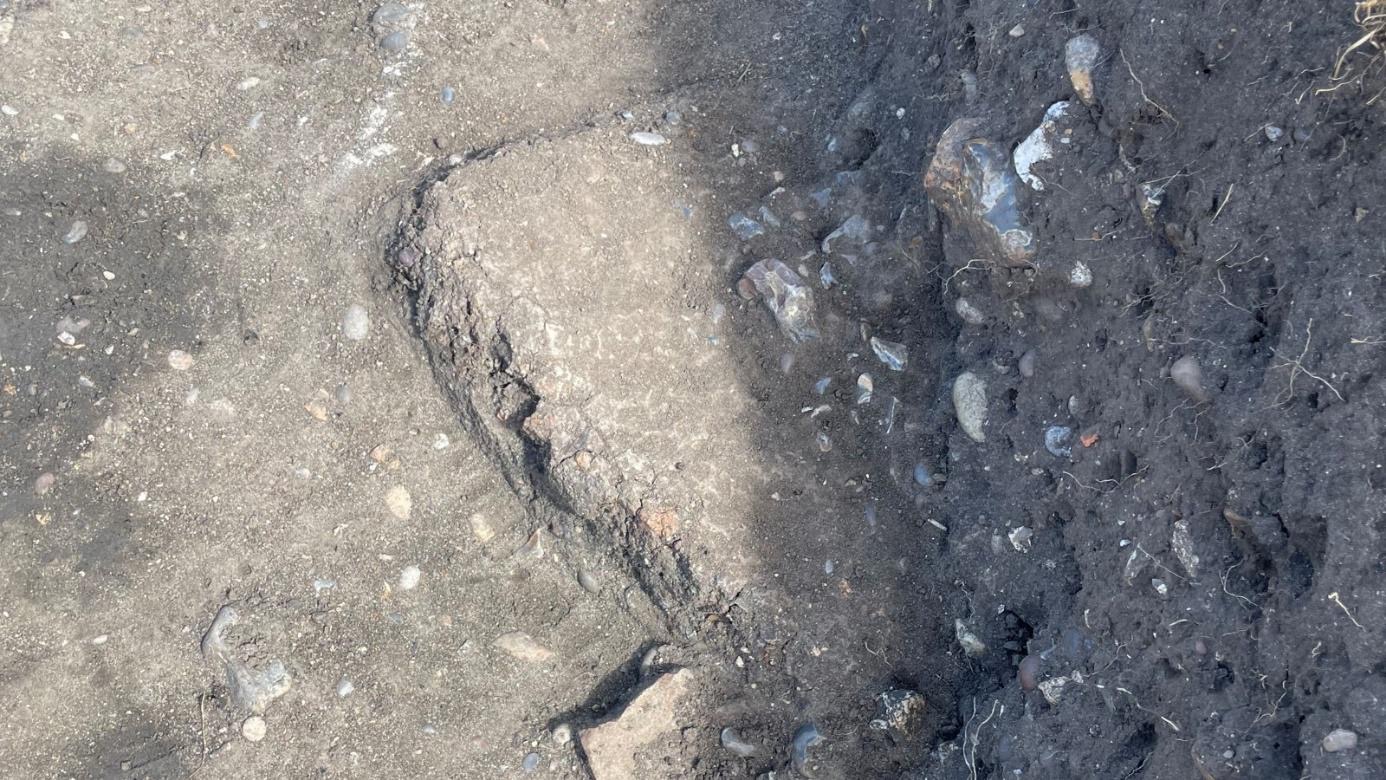
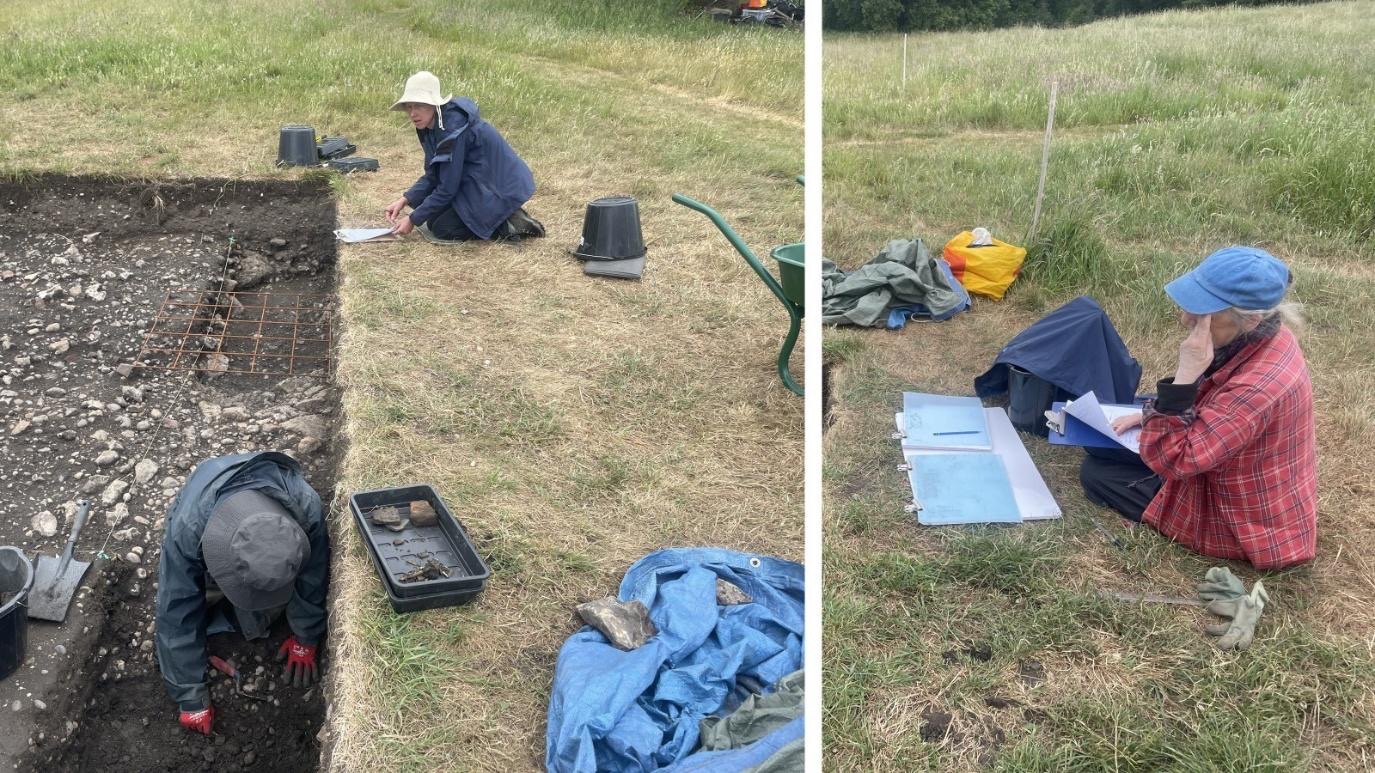
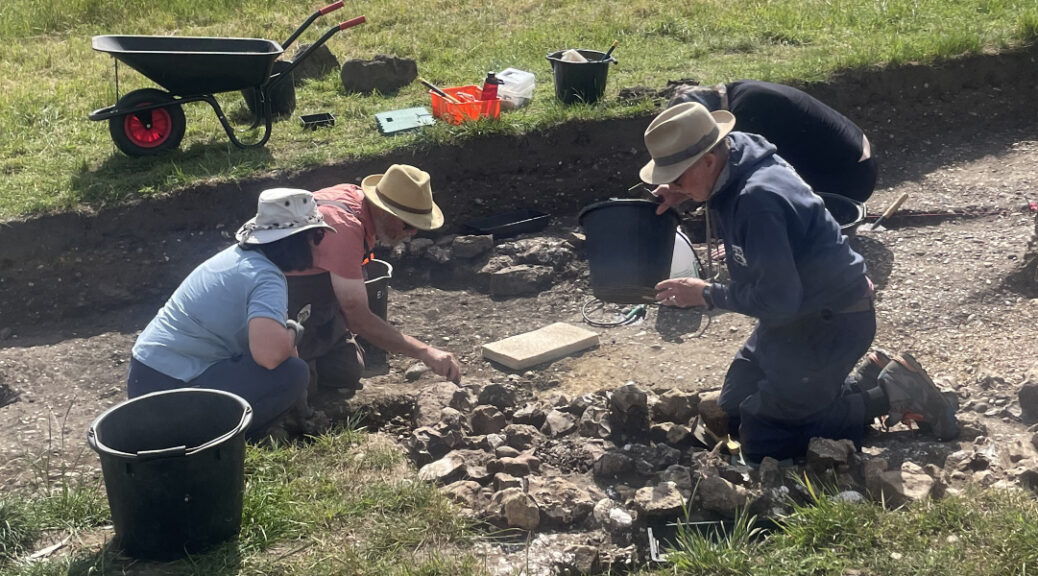
Once again the weather today was a bit “hit and miss”, but we managed to achieve a full day of excavation with only short bursts of heavy rain forcing us to retreat to the cars for a few minutes. In Trench 15 work continued apace to extend the archaeological horizon revealed earlier in the week. A sondage excavated by Peter showed another cobbled surface some 25cm below the current surface shown in Figure 1 and just above natural. At present there is no clear evidence of the building discovered in 2025 a few metres to the north of Trench 15 but it is possible that the remains of its beam slot foundations will be revealed in the coming days… The spoil removed from each context was carefully sifted by Margaret and Debbie as seen in Figure 2, who found pottery, iron objects and glass fragments dating to the Roman period.  

Figure 1. Merrill, Jill and Peter defining the newly revealed surface in Trench 15 
Figure 2. Margaret and Debbie sieving spoil from Trench 15

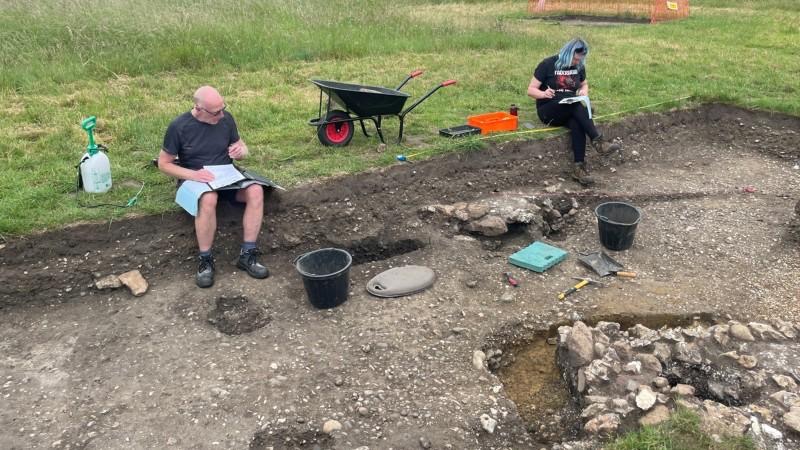
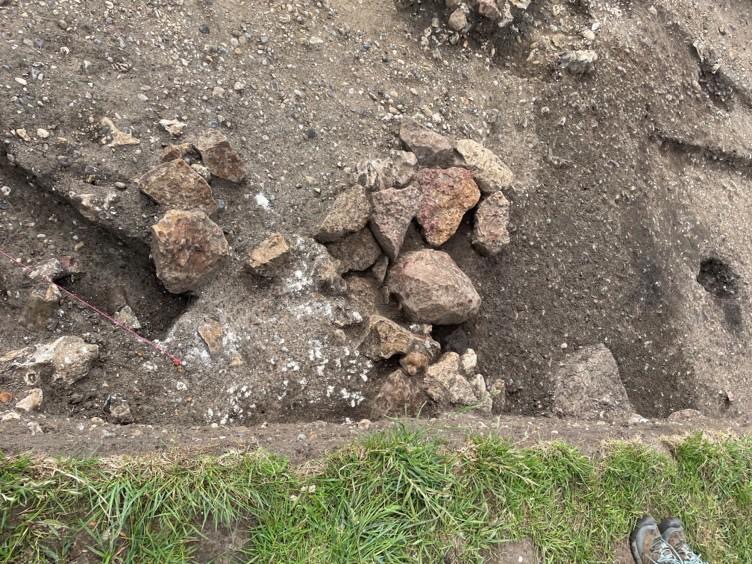
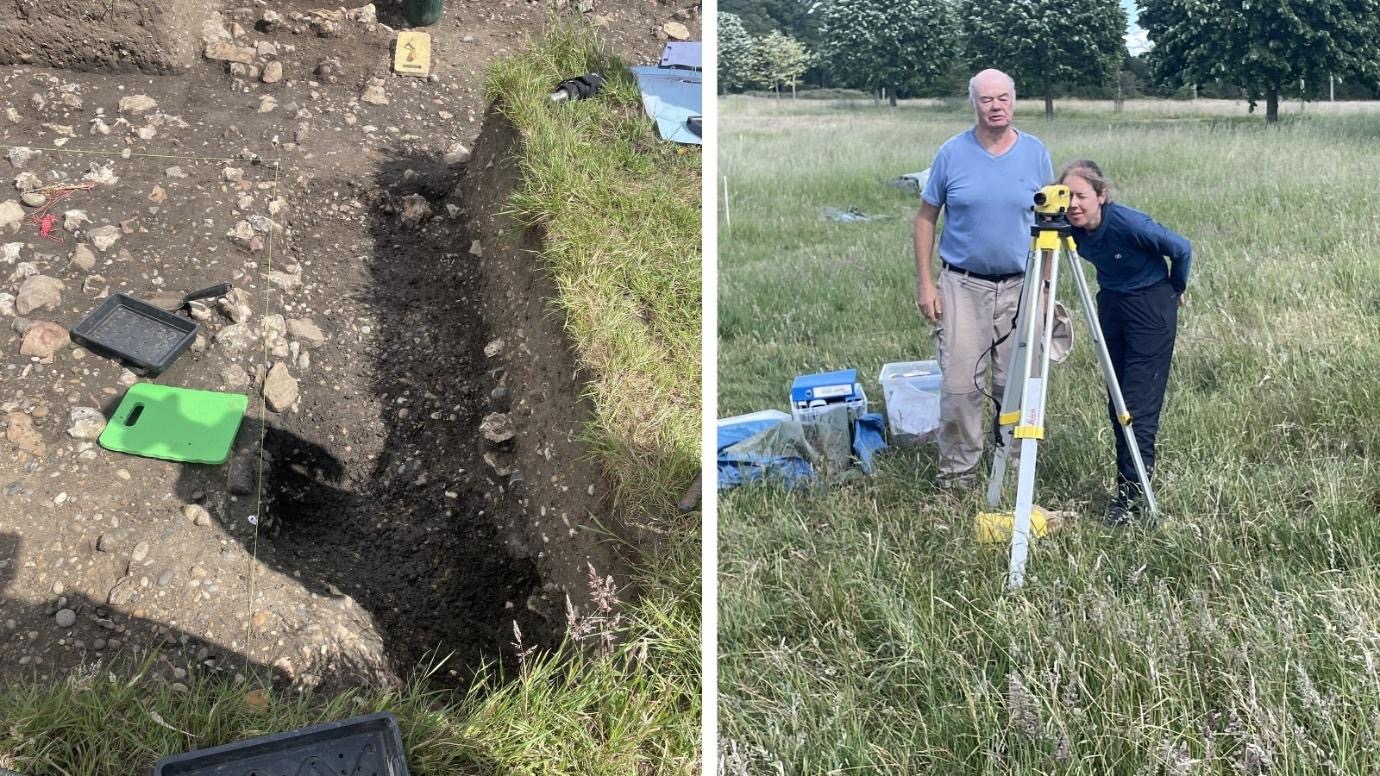
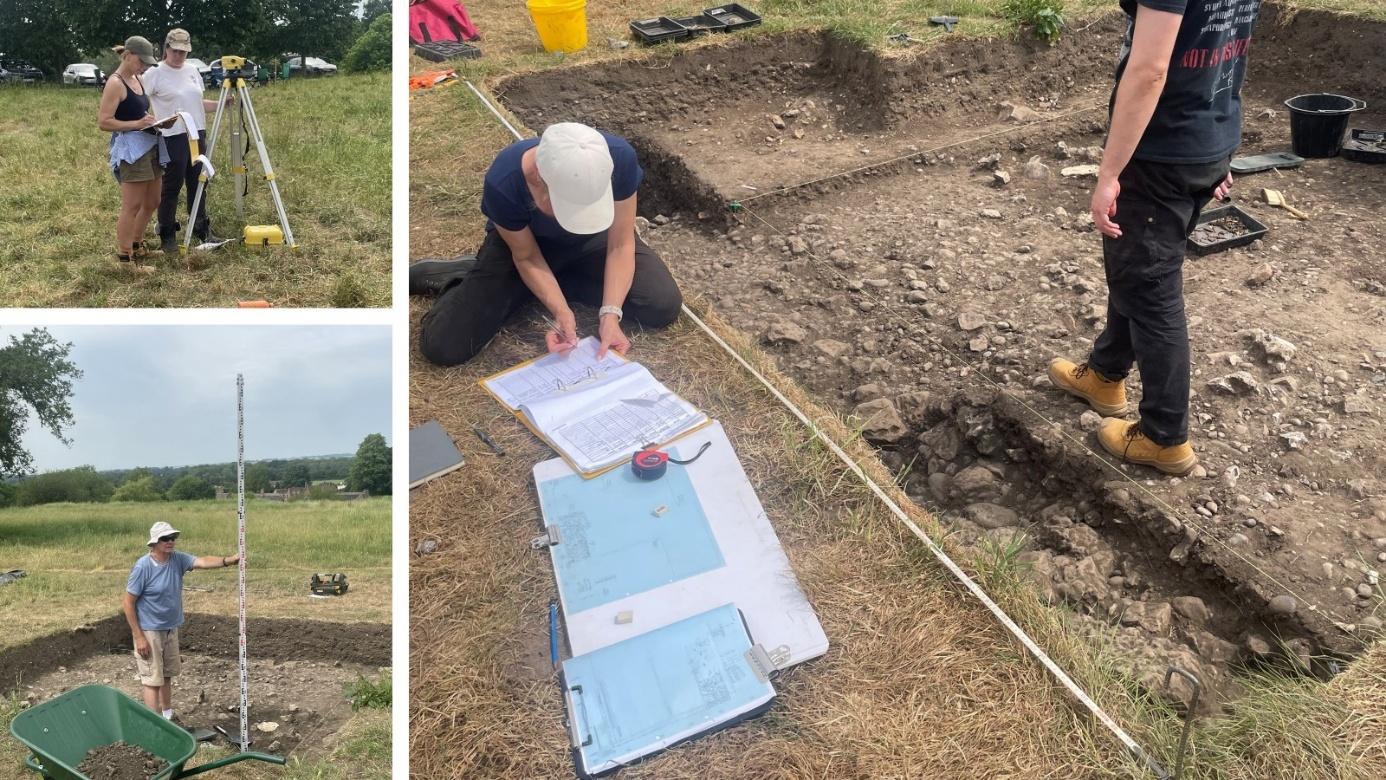
Today’s focus in Trench16 was cleaning and recording, with Gill and Lindsey completing the section drawings across the furnace pit and flue, and defining the masonry of the flue. Meanwhile Geoff cleaned a spread of rubble to the east that also included a chalk deposit suggesting a second flue. This interpretation was further hardened by Ben and Matthew who focused on planning a possible second furnace pit.

Figure 3. Lindsey and Gill stretching after defining the masonry flue wall in Trench 16
Figure 4. Ben and Matthew planning new features revealed in Trench 16

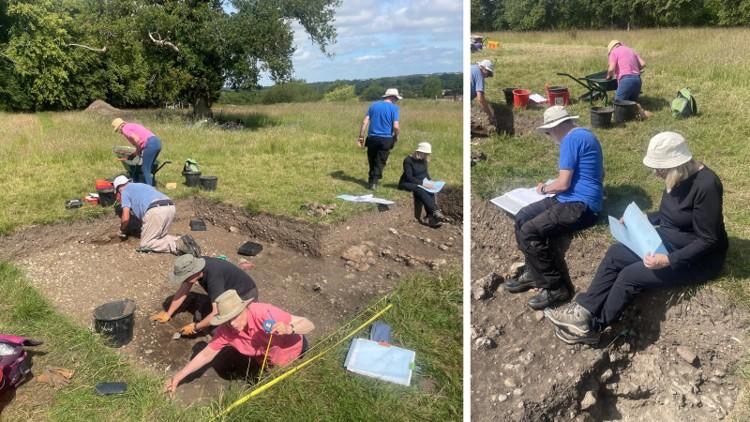
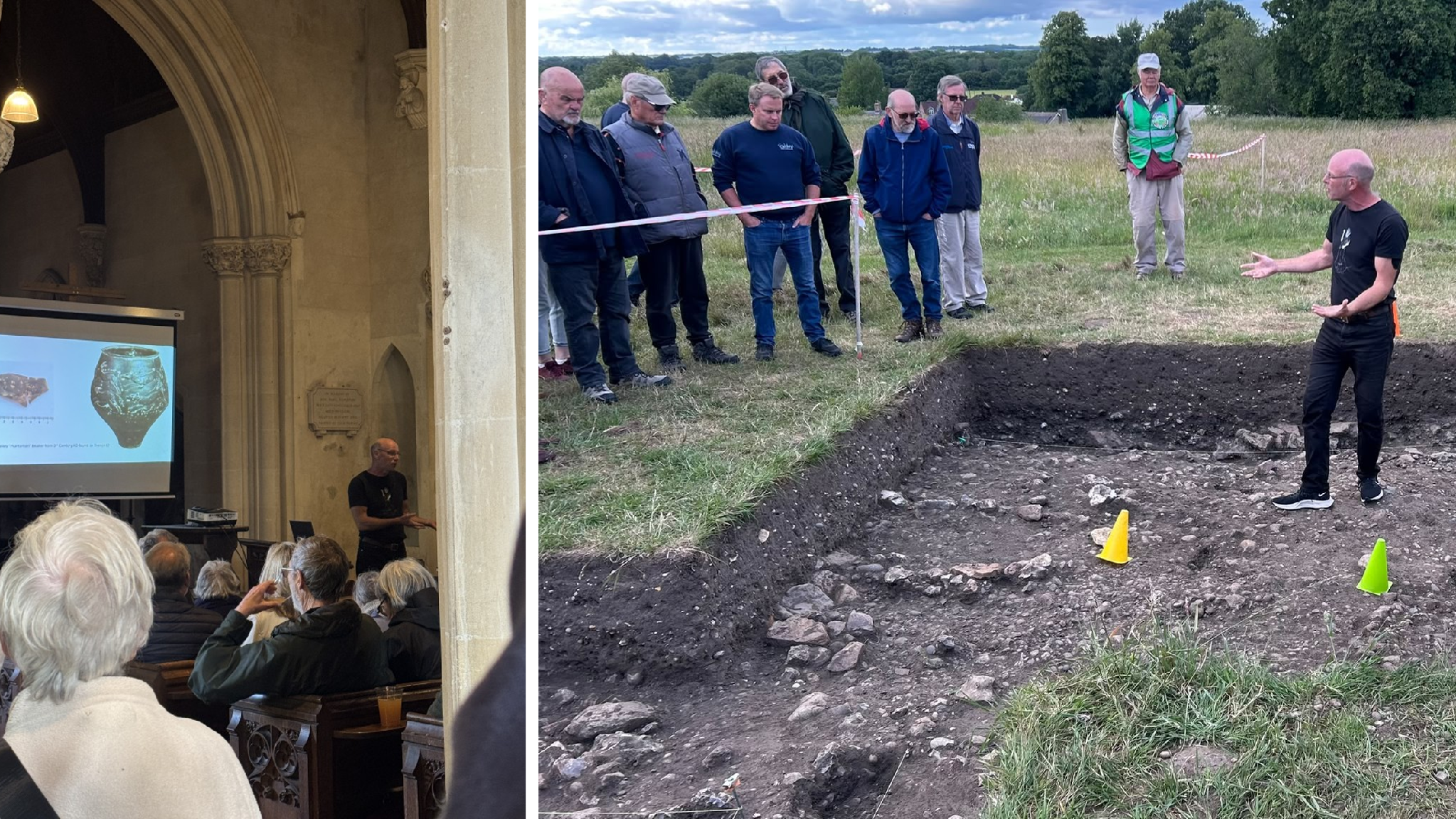
We were very lucky to have Phyllida Shelley with us on site today, an artist based in Cookham who has spent a number of years capturing different aspects of archaeology (and archaeologists) in her highly creative work. Figure 5 shows Phyllida capturing the subtle colours of the flue section being cleaned and recorded by Gill and Lindsey.

Figure 5. Phyllida capturing activity on site through an artists’ eye

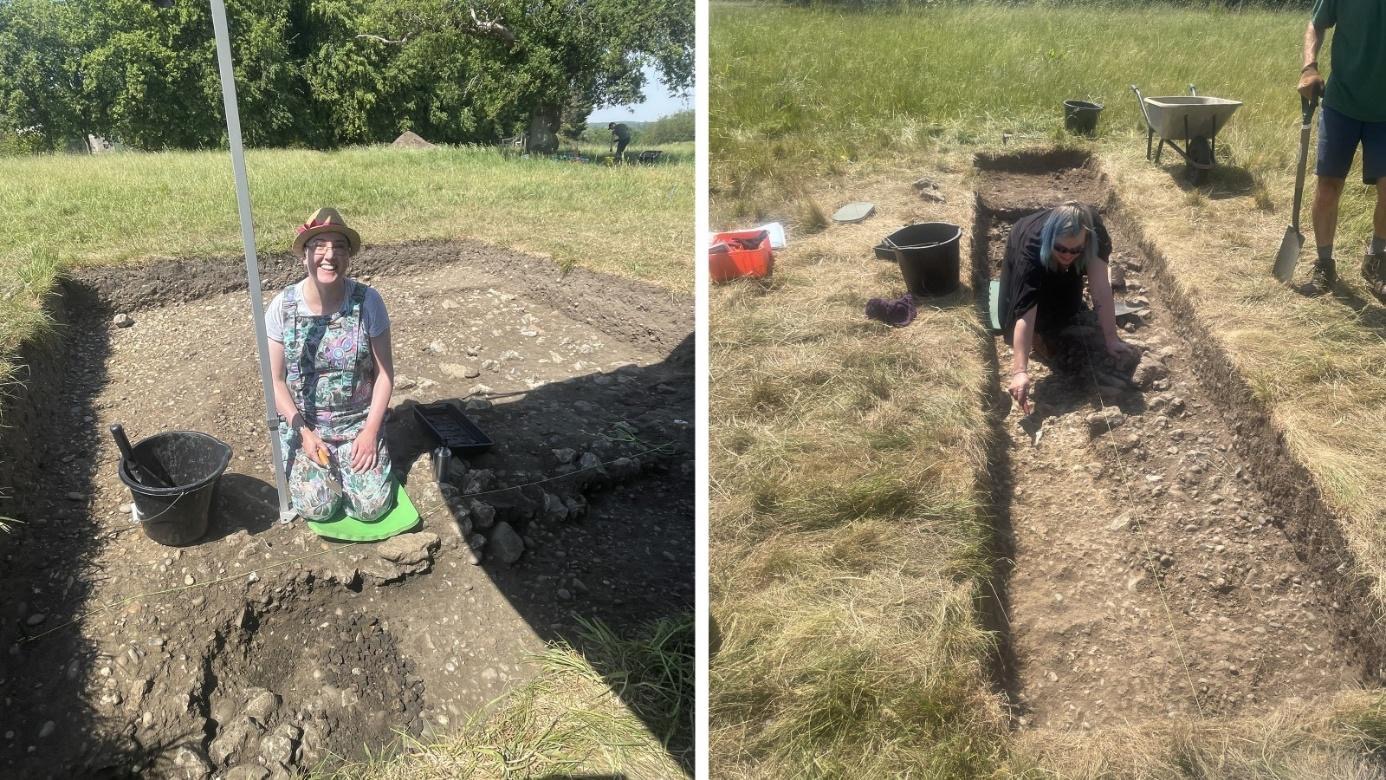
In Trench 17 Fiona and Chloe revealed new features at the bottom of the roadside midden deposit including additional large discarded pots. Around the pottery were large amounts of bone and slag, which together will help to characterise nearby occupation of this site. The large pottery fragments will be left in situ for the time being, but will be lifted at the end of the project to be identified by our pottery specialist and hopefully dated to indicate the time frame of these midden deposits.

Figure 6. Fiona and Chloe cleaning the large pottery fragments at the bottom of the midden deposit within Trench 17

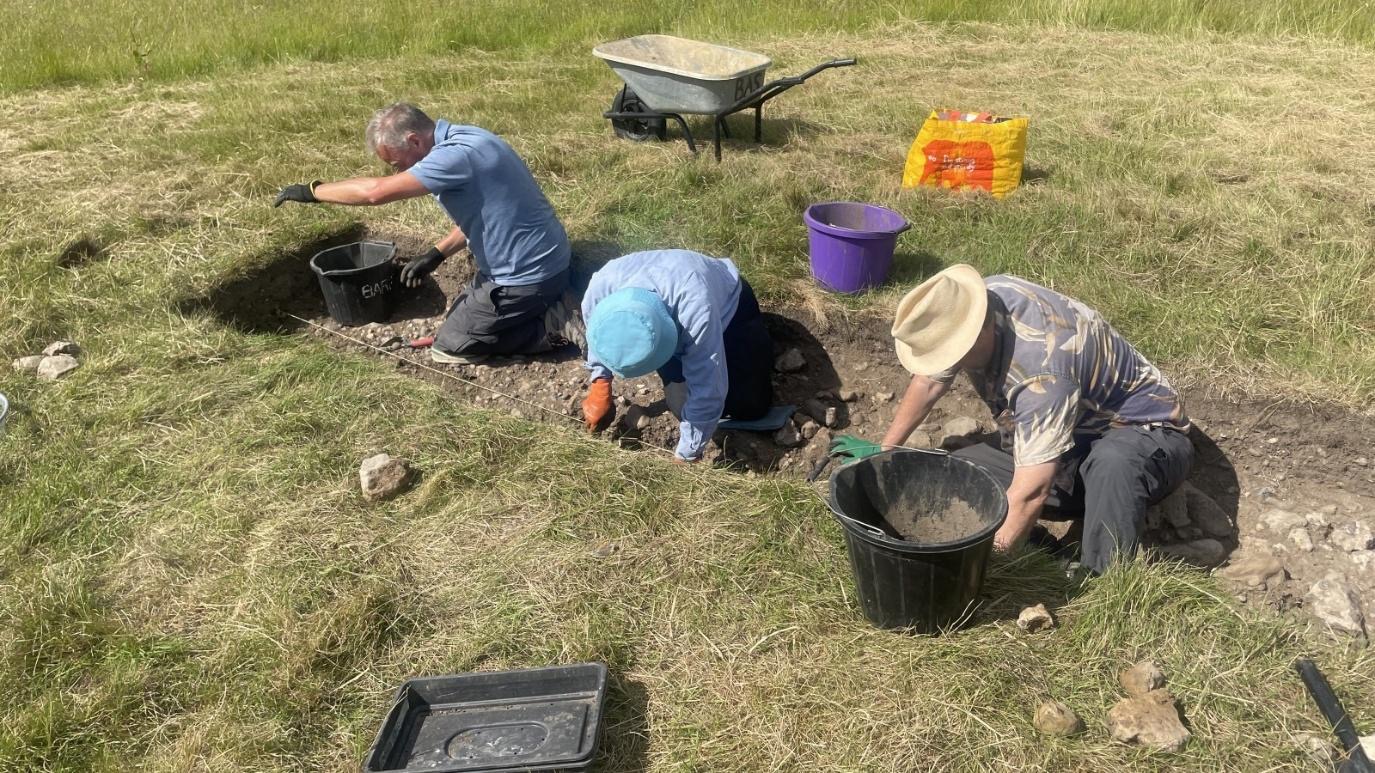
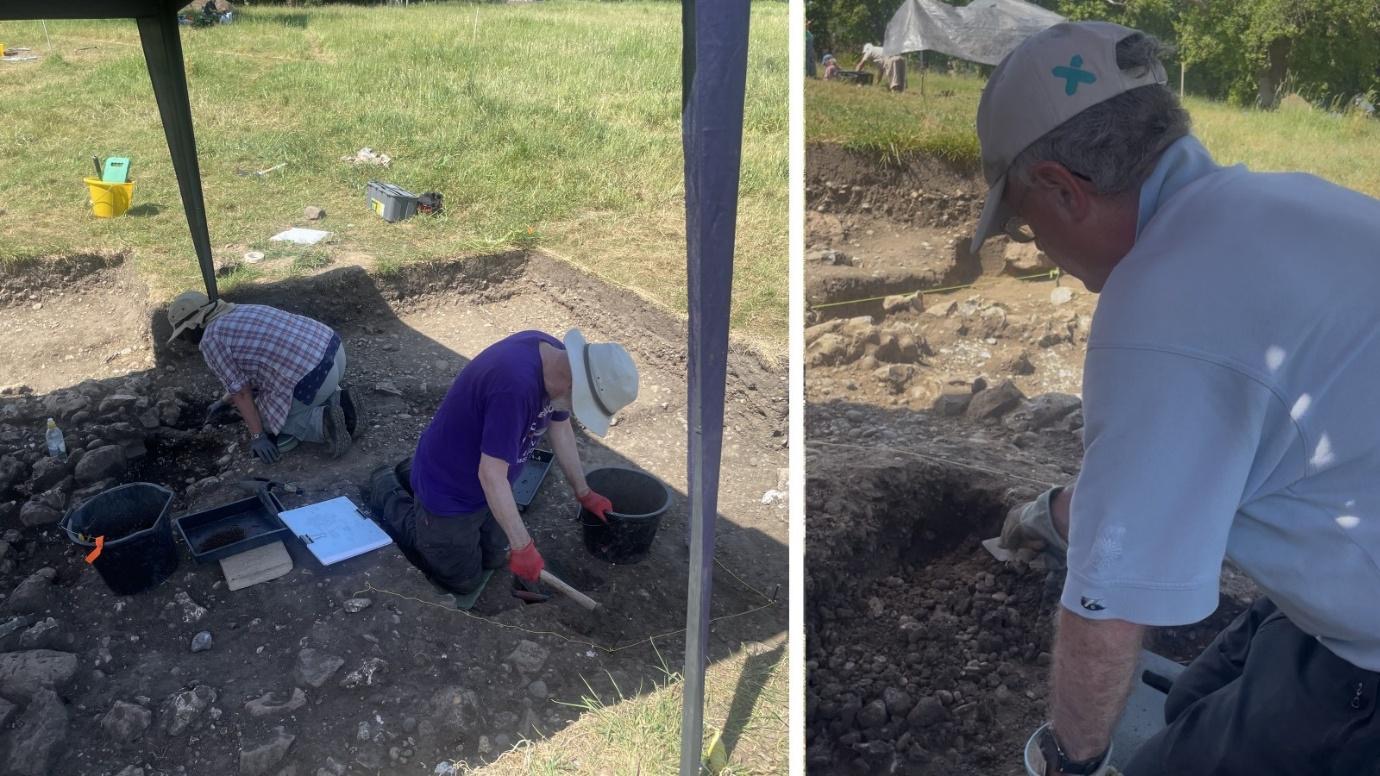
Having removed the turf for Trench 18, Gordon, Peter Ca and Julian continued to remove the overburden. However the first hints of deposits of large flints were soon discovered in the area indicated by the earth resistance geophysics surface, with a cobbled surface to the south and more friable soil where the roadside ditch is expected to lie. These positive indications will be examined further next week as the overburden is removed.

Figure 7. Promising early results from Trench 18

Whilst the excavation was taking place in Wickham the team of volunteers in Marcham led by Simon continued to clean and sort the finds from this year’s excavation. Much tea and many biscuits were consumed, and lots of progress made – and we are looking forward to examining the assemblage of finds from this year’s excavation in more detail during the post-ex phase of the project over the coming months…

Figure 8. Volunteers in Marcham processing finds from this year’s excavation

Wickham House 2026 – Day #20 Blog (13th May)

Part of a series of bulletins from the BAS excavations at Wickham House

Follow the project on our YouTube channel

Attendees: Julian, Geoff, Paula, Michael, Merrill, Gordon, Tony, Tim H, Simon, Eric, Nigel S, Gill, Lindsey and Keith 

The weather today was a bit “hit and miss” with alternating bright sunshine/heavy rain showers, however today’s team of volunteers made excellent progress. In Trench 15 Paula, Nigel S, Michael and Simon continued to make progress in cleaning the surface revealed the previous week and identifying the different contexts that define the lane branching north from Ermin Street, the ditch along the road (and lane) and the occupation area in the northeast of the trench. By the afternoon Michael had already started planning and recording, and tomorrow the other two areas should also be ready to record their newly revealed contexts. 

Figure 1. Paula, Simon and Michael at work in Trench 15

In Trench16 Lindsey and Gill continued the section recording started the day before by Jill, whilst Merrill, Gordon, Geoff and Eric continued to remove the layer of cobbles on top of the large flints thought to define the eastern masonry wall of the corn drier/malting shed. However, what was revealed was a second circular deposit of burnt material the same size as the furnace pit already revealed 2m to the west – and further deposit of chalk similar to that seen between the flint walls of the flue 2m to the west. This could suggest that a number of corn driers/malting sheds were built on this site over an extended period of time with the same morphology? Once this new surface has been recorded, further work will be required to unpick these possibly separate structures and identify their chronologies…

Figure 2. A rare shot of Keith on other side of the camera – and Geoff/Merrill cleaning the newly revealed surface in Trench 16.

A small ammounrt of recording was done in Trench 17 first thing in the morning to bring trench records up to date, then the team refocussed on opening a new trench (Trench 18) across what we expect to be the ditch along the southwest facing side of Ermin Street and a linear high resistance feature seen on last season’s earth resistance geophysics survey aligned with the Roman road. Turves were removed and by the end of the day the tops of large flints had started to appear where the high earth resistance linear feature was thought to be located. So far, so good – but more work will be needed to define the features in this trench that aims to assess the extent that occupation on the south side of the Roman road was different to that seen on the north side of the road.

Figure 3. Tim H, Julian and Tony opening Trench 18 between rain showers…

After yesterday’s’ exciting coin find, the top discoveries today were pottery. In trench 16 Gordon discovered this large fragment of decorated pottery with relief decoration with a red slip, possibly manufactured in Oxfordshire. It is hoped that the  distinctive pattern and fabric will enable our pottery specialists to identify a date as well as the place of manufacture. In Trench 15, Simon discovered a piece of mortaria (only the 5th fragment of mortaria found on this site to date) that also has a similar red slip and pale orange fabric – and may also have been manufactured in Oxfordshire.

Figure 4. Interesting fragments of pottery found in trenches 16 and 15

Wickham House 2026 – Day #19 Blog (12th May)

Part of a series of bulletins from the BAS excavations at Wickham House

Follow the project on our YouTube channel

Attendees: Julian, Geoff, Doug, Chloe, Debbie S, Paula, Michael, Millie, Merrill, Gordon, Nick, Jill and Keith 

In Trench 15 Paula, Debbie, Millie and Michael continued excavating the two slots across the surface that were started the previous week, and by the end of the day were starting to see clear delineations in the surfaces revealed. These surfaces were allocated context numbers, recorded on context sheets, planned and photographed. There is still quite a bit of work still to be done to identify and correlate the features seen in this trench, but one again considerable progress was made…

Figure 1. Features being revealed by the team in Trench…

Building on the back of the “heavy lifting” in Trench 16 the previous week, Merrill, Gordon and Geoff set about cleaning the surfaces revealed, focusing on the flint walls of the eastern side of the corn drier/malting shed. Finds discovered within the remaining parts of the surface above these features were carefully collected should they be needed for terminus ante quem dating evidence. Jill spent the day carefully recording the section across the collapsed flue and updating the records of these contexts.

Figure 2. Jill, Geoff, Merrill and Gordon at work in Trench 16

Just at the day’s excavation was drawing to a close Julian discovered a silver denarius serratus close to the corn drier/malting shed in Trench 16. This coin appears to date from around 82BC when it was minted by or in honour of the Praetor Antonius Balbus in Rome. The obverse shows the head of Jupiter (and the “SC” mint mark), and the reverse shows the goddess Victory driving a quadriga while holding a palm leaf. The coin is well worn, suggesting a long “use life” prior to being deposited, but whether we will be able to determine how this Late Roman Republican coin came to be deposited in Wickham remains to be seen. However, this is the earliest find discovered on this site to date, and for this area of West Berkshire is an unusual artefact to be discovered in an archaeological context.

Figure 3. The silver denarius revealed in Trench 16

In both Trench 15 and 16 much of the work today was spent recording, planning, sectioning and photographing the newly revealed features – and also completing/correcting/augmenting the records previously made to ensure the data collected is as complete and correct as possible. This consolidation of trench records will continue to be a key focus for both trenches for the next couple of days.

Figure 4. Jill and Millie updating trench records

Meanwhile in Trench 17 Doug, Chloe, Nick and Julian continued to excavated the roadside midden deposit revealing bone, pottery and industrial waste. This evidence will be rich source of data to characterise the lives of the inhabitants of this settlement, as well as those travelling along Ermin Street, during the Roman period.

Figure 5. Chloe, Doug, Nick and Julian at work in Trench 17
Figure 6. Some of today’s finds from Trench 17 

Wickham House 2026 – Day #18 Blog (8th May)

Part of a series of bulletins from the BAS excavations at Wickham House

Follow the project on our YouTube channel

Attendees: Julian, Susanne, Celia, Eric, Nigel B, Geoff, Ben A, Carrollanne, Doug, Peter Ca and Peter Cl and Keith 

In Trench 15 Ben A, Carrollanne and Peter Cl continued with the east-west section  across the north end of the trench to identify the extent of the lane (top), the lane’s ditch (mid) and the occupation area (bottom) which can be seen in Figure 1. Initial interpretations suggest that the lane ditch close to its intersection with Ermin Street is also filled with the same deposits of building rubble, which in a nearby section of ditch was dated to the late 4th Century AD. Now that the area of likely domestic occupation within Building #3 has been identified, excavation in the coming week will focus on revealing the remains of this building, its likely period of use, its function and how it interacted with the nearby lane/road. 

Figure 1. Carrollanne and Ben A revealing the likely lane ditch within a sondage in Trench 15.

In Trench 16 the muscle-power of Julian, Eric, Nigel B, Peter Ca and Geoff was focused on removing a 3m x 1m section of overburden to reveal the full extent of the wall of the corn drier/malting shed. Having done most of the “heavy lifting” by lunchtime, the team spent the afternoon cleaning the cobbled surface and a further section of flint wall. In the rest of Trench 16, Susanne and Keith brought the plans and context sheets up to date with the help of the GPS device, whilst Celia completed a section drawing of the fill of the furnace pit.

Figure 2.  Geoff, Eric, Nigel B and Peter Ca cleaning a newly revealed section of masonry wall.
Figure 3. Detailed planning in Trench 16…

Meanwhile in Trench 17 Doug and Julian continued to investigate the contents of the midden deposit, making some further exciting discoveries. The 1cm diameter bone gaming counter was a particularly nice find, as was the fragment of another bone hairpin. Whilst these finds may be difficult to date beyond the Roman period, they both give insights into the activities and identities of the Romano-British population living in/passing through this roadside settlement 

Figure 4. Julian and Doug excavating the midden deposit in Trench 17
Figure 5. Material culture found within the midden deposit in Trench 17

Wickham House 2026 – Day #17 Blog (7th May)

Part of a series of bulletins from the BAS excavations at Wickham House

Follow the project on our YouTube channel

Attendees: Julian, Martin, John H, Tim L, Chloe, Lindsey, Ben, Matthew, Anna, Kai, Susanne, Claire, David, Rod and Keith 

In Trench 15, Martin and team continued to excavate in a number of areas to the north of the Roman road to reveal the expected horizon of Roman occupation in/around Building #3 identified in 2025. Lots of Roman pottery and a 4th Century AD Roman numus coin were discovered, but as yet we are only getting hints of the archaeological horizon we encountered in the previous season. This Trench promises to be really exciting, so work will continue tomorrow…

Figure 1. A busy day in Trench 15!

In Trench 16, Ben and Matthew got the day off to an exciting start by discovering the return of the robbed out construction trench of the corn-drier (or possible malting house) to the southeast of the flint wall as shown in Figure 2. This discovery suggests that the corn drier is of a “U-shaped” configuration, and work will continue tomorrow to reveal the full outline of this structure so it, and the areas surrounding it, can be analysed in more detail for dating the period when it was in use and who might have been using it…

Elsewhere in Trench 16, Lindsey and Susanne continued with the recording of the furnace pit and flue, whilst Tim L excavated the beam slot at the north end of the trench. With the number of discoveries made in this trench in the past few days there is still plenty of work to be done, but good use was made of the GPS device to accurately position features within the trench on plans being recorded.

Figure 2. Lindsey and Susanne recording the furnace pit area of Trench 16
Figure 3. Tim L carefully excavating a section of the beam slot in Trench 16

Meanwhile in Trench 17, Julian and Chloe spent the morning finalising the records of this trench to ensure all the features revealed had been included. Then they continued to half section the trench to reveal more of the “natural” surface uncovered earlier in the week. This resulted in a really interesting piece of Nene Valley colour coated ware pottery being found by Chloe together with fragments of Samian pottery. The Nene Valley pottery sherds featured relief decoration of a deer or horse suggesting that this was from a “hunt cup” beaker that were being produced in the 2nd and 3rd Centuries AD, and hopefully can be more accurately dated by our pottery specialist. This high status tableware is known to have been popular with individuals within the military as well as the rural elite, so may give us further clues to the identities of the occupants of this area of Roman Wickham during the Early Roman period!

Figure 4. Samian pottery sherd discovered by Chloe
Figure 5. Fragment of Nene Valley pottery also found by Chloe –  and its likely identification

Wickham House 2026 – Day #16 Blog (5th May)

Part of a series of bulletins from the BAS excavations at Wickham House

Follow the project on our YouTube channel

Attendees: Julian, Geoff, Martin, Jill, John H, Tim L, Chloe, Debbie S, Celia, Roger, Thalia, Lindsey, Malcolm and Keith 

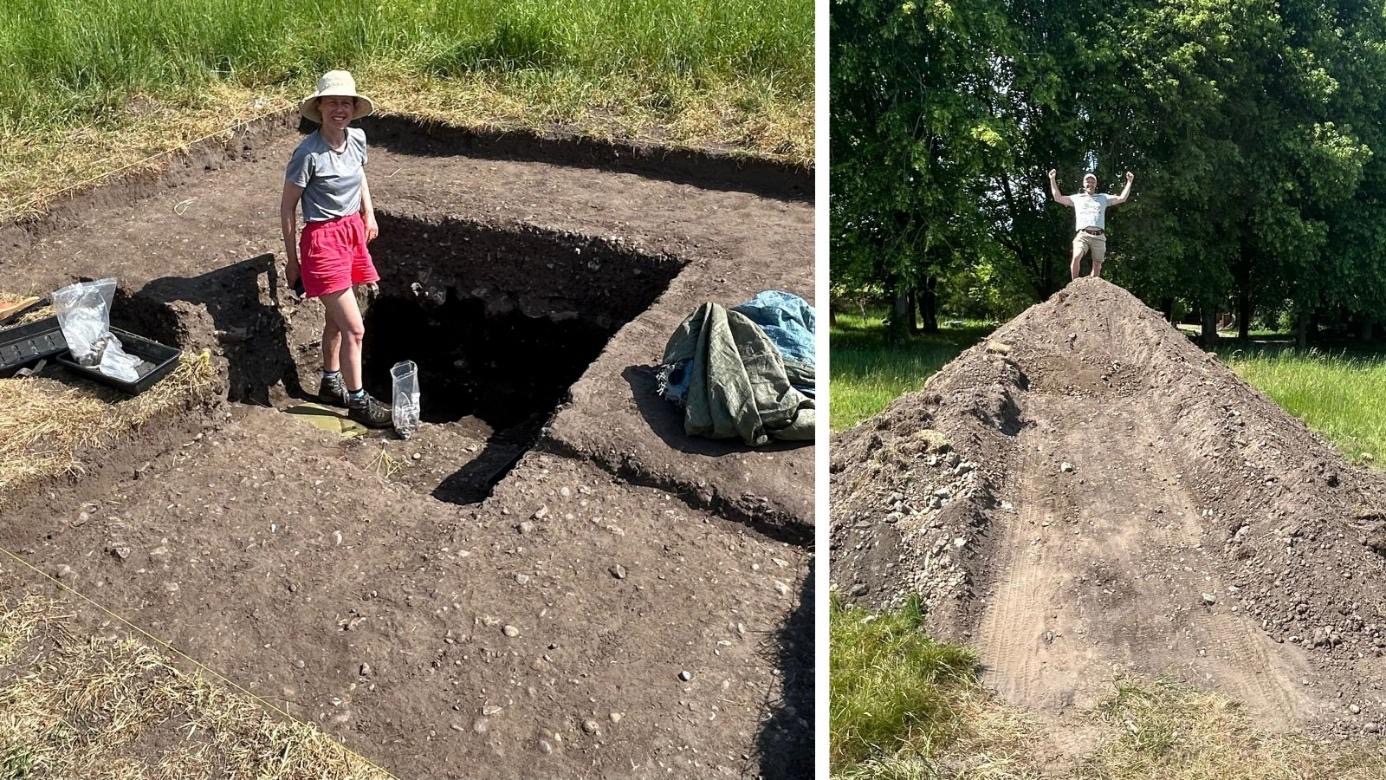
Over the weekend our ever growing spoil heap was kindly reprofiled once again by Mark (the groundsman at Wickham House) with his tractor, which made a huge difference to the team members doing today’s “heavy lifting”. Thanks Mark!

Figure 1. The newly reprofiled spoil heap

In Trench 15 work continued in the north of the trench to find the archaeological horizon where it is hoped that evidence of the southwest corner of Building #3 is expected to be revealed. The other question to be addressed is the extent of the ditch along the lane and whether it intersects the road ditch. 

Figure 2. Martin, Debbie S, Celia, Jill, Malcolm and Thalia working in Trench 15

In trench 16 the day started with John, Chloe and John H removing part of the berm at the south of the trench which revealed more of the cobbled surface already seen in the main part of this trench. Once this new surface has been planned and recorded, work will continue to see if the return of the flue heading to the southeast continues beneath the cobbled surface – and if so to assess the layout of the corn-drier flue which will help to characterise this part of the site and its likely date of use. In the south of the trench Lindsey continued to work on the furnace pit which she started to half section SW-NE to remove flints/chalk that had slumped into the pit so the cut profile can be seen in full, and further samples gathered for environmental analysis. Martin, Keith and Tim spent the day accurately planning the outline of Trench 15 and Trench 16 with the GPS device and updating the plans of both these trenches to bring them into alignment with the single context plans recorded to date.

Figure 3, Lindsey, Tim L, Chloe, Geoff and John at work in Trench 16
Figure 4. Lindsey preparing to half section the flint/chalk fill of the furnace pit

Meanwhile in Trench 17, Julian and Roger set about opening a sondage through the lower levels of the roadside midden deposit, and was rewarded by locating the likely natural deposits with a spread of large fragments of possibly dateable pottery lying directly on top.

Figure 5. Roger and Julian excavating the sondage in Trench 17

Wickham House 2026 – Day #15 Blog (30th April)

Part of a series of bulletins from the BAS excavations at Wickham House

Follow the project on our YouTube channel

Attendees: Kate, Claire, Julian, James P, Ben C, Geoff, Philip, Phil C, Martin, Stewart, Jill, John H, Phil C, Tim L, Doug, Nigel B and Keith 

We are now 1/3 of the way through this season’s excavation, and looking back we have already made a huge amount of progress. This has been partly due to the excellent weather, which has so far given us a 100% days of good weather for planned survey days – long may it continue! 

In Trench 15 Martin, Claire, Geoff, Stewart, Phil C, John and Nigel B continued to clean back the surfaces to the northeast of where the lane intersects the Roman road. Having reached the archaeological horizon for most of this area, Roman period finds of pottery and CBM quickly began to emerge together with nails and a few pieces of glass. Work will continue next week to better define the surface of the lane, the surface of the fill of the lane ditch, the occupation surfaces – and the southwest corner of the building identified in 2025 a few meters to the northeast.

Figure 1. Martin, Claire, John and Phil C cleaning a cobbled surface in Trench 15

In Trench 16 some great progress was made by James P, Tim L, Kate and Ben. Having established yesterday that the masonry feature was most likely a flue – probably of a corn drier, Kate continued to clean up the pit at the southwest end of the flue into which the flue had collapsed leaving a deposit of chalk/flint. Meanwhile James cleaned up the section through the flue opened in 2025 to remove the block sample shown in Figure 3 which clearly shows the collapsed mortar upper surface of the flue onto the bed of ash lying beneath. 

Figure 2 Kate and James P carefully exploring the furnace pit and collapsed flue section of the corn drier
Figure 3. Block sample taken from the collapsed flue section

At the north end of the Trench 16, Tim was focusing on defining the possible beam slot on the same alignment as the flue to assess whether this was part of the corn drier built on top of the flue, or whether this feature was part of an unrelated building. The north end of the flue does not appear to have the commonly seen “T shape” of many Roman period corn drier flues, so Ben was exploring a possible return to the southeast to assess whether this flue has the “U shaped” morphology…

Figure 4. Cleaned half section of the corn drier furnace pit
Figure 5. Tim L carefully excavating a possible beam slot to the north of the flue

In Trench 17, having lifted the deposit of flints to reveal a midden deposit beneath, Julian continued with a sondage to establish how far below the surface of the midden natural can be found and to establish whether the anomalies seen on the Ground Penetrating Radar at a depth of 0.80m to 1.00m could be located. So far the bottom of the midden has not been located, but continued to reveal many items of pottery dating to the 2nd-3rd centuries AD, animal bone and slag.

Figure 6. Julian in his “office” in Trench 17…

It was the final day of the geophysics survey for this summer season at Wickham House, but Philip will continue working behind the scenes to process the huge amount of data that has been collected by “team geophys” and identifying further targets for us to investigate as we close in on our research objectives. The final day collected a highly respectable 14 grid squares, and the draft results are shown below in Figure 7.  Once again, the geophys surveys have proved invaluable in homing us in straight onto interesting archaeology – and it will be interesting to reflect on the additional benefits that Ground Penetrating Radar might add to the BAS geophys armoury moving forward…

Figure 7. The earth resistance survey image along Ermin Street.

Wickham House 2026 – Day #14 Blog (29th April)

Part of a series of bulletins from the BAS excavations at Wickham House

Follow the project on our YouTube channel

Attendees: Stuart, Julian, James P, Ben C, Gill, Emily, Sofia, Geoff, Carrollanne, Lindsey, Philip, Phil C, Martin, Andrew R, Peter and Keith 

In Trench 15 Martin, Keith and Geoff focussed on extending the horizon of archaeology across the northern end of the trench where the southwest corner of a Roman period timber framed building is projected to extend. The northeast corner of this building was discovered nearby in 2025,  and a key objective for this season is to understand the relationship between this building and the intersection of the lane/Roman road. Not only did this involve several hours of hard mattocking, but cleaning the surface revealed and sieving using a trowel. 

Figure 1 Martin and Geoff hard at work in Trench 15
Figure 2. Julian “on patrol” on the spoil heap…

The volume of spoil created from Trench 15 also kept Julian busy during the breaks keeping up his regular “patrol” of the spoil heap looking for metal artefacts overlooked! Back in Trench 17 Julian and Carrollanne manged to removed the layer of flints lying on top of a deposit of “dark earth” containing Roman pottery, bone and slag. Tomorrow the plan is to remove the “dark earth” in spits to assess whether there further archaeology lying beneath as predicted by the Ground Penetrating Radar…

Figure 3. The deposit of “Dark Earth” in Trench 17…

Today was a busy day in Trench 16! Ben completed recording the pebble layer revealed the day before and began a sondage to explore the deposits beneath the pebbles to assess how far features seen to the west of Trench 16 extended to the east. 

Figure 4. Ben completed his recording of the latest context

Stuart and Lindsey continued to explore the area of possible burning at the southwest end of the masonry structure, whilst James cleaned up the slot across the masonry structure excavated in 2025. Whilst the presence of a furnace in the southwest has still to be confirmed, James and Stuary revealed evidence of the collapsed flue in the section which now strongly suggests that the masonry structure revealed is part of a flue. The flint shown in Figure 5 not only has been exposed to heat but has a layer of plaster and a thick covering of ash – and may have been part of the now collapsed roof of the flue.

Figure 5. James cleaning up the section where the part of the flint roof of the flue was discovered

Emily and Sofia cleaned up the surface to the north of Trench 16 revealing a linear cut of a possible construction trench aligned with the masonry flue, whilst Phil C explored a possible return of the flue to the northeast.

Figure 6. Emily, Phil C and Sofia working in Trench 16
Figure 7. Lindsey excavating the possible furnace pit in the southwest of Trench 16

To the southeast of the excavation site, Philip, Andrew R, Gill and Peter continued with the high resolution (0.5m) earth resistance geophysics survey to assess the extent of roadside settlement to the southeast along Ermin Street.

Figure 8 Andrew and Peter collecting earth resistance survey data

Wickham House 2026 – Day #13 Blog (28th April)

Part of a series of bulletins from the BAS excavations at Wickham House

Follow the project on our YouTube channel

Attendees: Stuart, Julian, Thalia, Millie, Ben, Kira, Jean, Jill, Malcolm, Geoff, Carrollanne, Lindsey, Philip, Phil C, Martin, Debbie C, Jill, Tim L, Tim H and Keith 

In Trench 15 work again focussed on removing topsoil from the north end of the trench to reveal the occupation surfaces west of the lane. The mattocking/wheelbarrowing proved a useful means of keeping warm in the strong northerly wind! Keith and Martin updated the plans and context sheets so that the trench records were up to date, and Carrollanne discovered a beautiful Roman melon bead AND part of a Roman copper-alloy nail cleaner as seen in Figure 2. Both these finds are amazing – melon beads are particularly associated with military sites as they are believed to have been worn by soldiers as tokens of ‘good luck’. These finds not only emphasis the role of Ermin Street as a military supply route from Silchester to Carleon, but the nail cleaner also speaks to the large number of finds from the local civilian population of Roman Wickham.

Figure 1. Debbie, Carrollanne, Martin and Geoff excavating in Trench 15
Figure 2. An exciting day for finds in Trench 15 with Carrollanne finding a glass melon bead (left)  AND part of a copper-alloy nail cleaner (right)!

Meanwhile in Trench 16 Stuart and Lindsey continued the excavation of the pit at the southwest end of the masonry wall to investigate if could have been an a area of burning that might indicate a possible industrial function of the masonry wall, however further areas of the chalk mortar were revealed together with Roman colour-coated pottery and a fragment of a shale bracelet – so further work is required to explain this complex series of deposits. 

Figure 3. Lindsey and Stuart excavate a pit at the southwest end of the masonry wall.

At the north end of Trench 16 Jean and Tim L were looking for features identified on the GPR survey. At the other end of the trench Kira and Ben revealed a new horizon of archaeology that it is also hoped will shed further light on the structures being revealed in this trench…

Figure 4. Ben cleaning the southeast corner of Trench 16

In Trench 17 Millie, Thalia and Julian started to remove the upper layer of the flint deposits revealed last week, that now appears to have been sitting directly on top of the deposits of ‘dark earth’ rich in pottery/bone artefacts seen on the west side of this trench. Work stopped to record, photograph and take levels – and will continue tomorrow to identify archaeological features beneath to assess whether they correlate with the GPR anomaly seen at this depth and location when surveyed at the start of this season’s excavation. Millie also found her first Roman coin in context – an eroded 4th Century AD numus! 

Figure 5. Thalia updating plans and context sheets for Trench 17
Figure 6. The deposit of large flints partially removed in Trench 17 revealing a horizon of ‘dark earth’ beneath…
Figure 7. Millie having just discovered her first Roman coin in context in Trench 17

The geophysics phase of the project entered its final week of data collection. Today Philip, Malcolm, Tim H, Phil C and Jill captured an impressive 12 grid squares of data. Today’s results show the Roman road start to fade from view as it heads northwest, but there are further hints of new rectilinear roadside features emerging that will add new insights into the extent and possible functions of this roadside settlement…

Figure 8. The earth resistance geophysics image at the end of Day #13

Wickham House 2026 – Day #12 Blog (23rd April)

Part of a series of bulletins from the BAS excavations at Wickham House

Follow the project on our YouTube channel

Attendees: Stuart, Julian, Lindsey, Philip, Doug, Nigel B, James P, Martin, Debbie, Carol, Phil U, Jill, Nick, Rod, Tim H and Keith 

In Trench 15 Debbie, James P and Martin  put in a huge amount of work, with Debbie patiently building on the work started the previous week to define the intersection of the Roman road with the lane branching to the north. By the end of the day the delineation between the two surfaces had been defined, with a clear interruption of the roadside ditch filled with building rubble seen to the southeast as seen in Figure 1. Nearby also in Trench 15, Martin and James P removed a significant amount of overburden in a quest to locate the surface of the lane to the northeast of where Debbie was working. By the end of the day this had been accomplished, and they were rewarded with the discovery of a (possibly “barbarous”) copper-alloy numus coin as seen in Figure 2. Having defined the Roman road/ditch and the lane, work will continue next week to determine if the lane ditch seen in 2025 extends to the south – and then to locate the horizon of occupation for the building discovered in this area in 2025…

Figure 1 Debbie defining the intersection of the road/lane in relation to the roadside ditch fill
Figure 2. Martin and James sorting their “loose” in Trench 15 where a coin was found!

In Trench 16 Stuart and Lindsey carried on with the first of the projects in this area to excavate a slot across a dark deposit discovered at the south end of the masonry wall. Their objective was to see if this was an area of burning that might suggest that the masonry structure was part of a corn drier or furnace. By the end of the day it was clear that this deposit was shallow, and further areas of chalk and large flints were discovered beneath – however work will continue in this area early next week to explore the newly revealed contexts in more detail…

Elsewhere in Trench 16 Tim H and Rod, and Susan, Phil U, Doug and Carol worked on opening up two new areas to investigate features as yet only partially revealed. Both areas were down to the archaeological horizon by the end of the day with many finds being discovered, mostly from the Roman period.

Figure 3 Lindsey and Stuart excavating a slot across the dark deposit in the south of Trench 16
Figure 4. Carol and Susanne, and Rod and Tim opening up new areas of Trench 16

In Trench 17 Nick and Julian were excavating two contexts of “dark earth” rich in Roman period pottery and bone deposits as seen in Figure 5. So far the large flints seen in the trench appear to be placed directly onto the “dark earth”, whereas the Ground Penetrating Radar  is predicting a rectilinear feature some 0.2m beneath the current limit of excavation… Work next week will hopefully reveal the archaeology  and hopefully correlate with the geophysics anomaly identified in this location. 

Figure 5 Nick and Julian at work in Trench 17 with their array of interesting finds
Figure 6. The ever growing spoil heap at the end of Day #12…!

At the end of week #4 of the excavation the size of the spoil heap in Figure 6 speaks of the progress made so far in each of the three trenches opened, and the research objectives for this season’s excavation are already being addressed. The earth resistance survey to the southeast of the excavation also continues to make great progress as shown in Figure 7, where Philip, Nigel B, Geoff and Jill added a further 11 squares to the survey grid.  So far rectilinear features can be seen on both sides of the Roman road adding considerably to our knowledge of the extent and morphology of this roadside settlement.

Figure 7. The Geophysics survey image at the end of Day #12

Not only is work continuing apace in the three trenches and the geophysics survey, but our trusty team of volunteers from Marcham have started work cleaning and sorting the finds made in the first four weeks of excavation. This team have many years of experience of post-excavation analysis of the Roman settlement at Frilsham, so it is a privilege to have them working with us (albeit remotely) on the excavation at Wickham. Figure 8 shows Sheila, Ricky, Carol, Simon and Murray hard at work cleaning and sorting our finds, and Figure 9 shows a number of the finds made to date post cleaning. The team will be sorting finds by context/type ready for post-excavation analysis to begin in earnest later in the year…

Figure 8. Sheila, Ricky, Carol, Simon and Murray hard at work cleaning and sorting finds
Figure 9 A small section of the finds discovered to date photographed by Simon…

Exploring the archaeology, history and heritage of Berkshire